
CONFUSION: A LEADING CAUSE OF WASTE?
SEPTEMBER 27, 2021 – HEARING THE WORD “WASTE” IMMEDIATELY ELICITS MENTAL IMAGES OF FULL GARBAGE CANS AND OVERFLOWING LANDFILLS. THOSE ARE OFTEN FOLLOWED BY CHARACTERIZATIONS OF THOSE RESPONSIBLE: PERHAPS CARELESS OR IRRESPONSIBLE. WHILE THAT MAY BE THE CASE IN SOME INSTANCES, THE REALITY IS USUALLY MORE NUANCED. BELOW THE SURFACE LIES A MUCH LESS OBVIOUS ROOT CAUSE FOR MUCH OF THE UNNECESSARY WASTE THAT ENDS UP IN OUR LANDFILLS.
Stories are a fun way to share information and the topic of confusion leading to waste is a great opportunity to share a small part of the Plus Brand story! However first, let’s start by establishing a fundamental baseline when it comes to our understanding and agreement on the legitimacy of the concept of confusion leading to waste. Let’s examine two similar examples.
First, a big one: Confusion over food product expiration dates leads to massive waste. An NRDC and Harvard Law legal analysis of loose and varied state and federal laws surrounding food labels found that confusion over how to interpret various dates and language leads to up to 40% of our food in the U.S. being thrown away. That is the equivalent of about $165 billion dollars worth. Lack of standardization of language used on labels regarding dates cause confusion; seeing a “sell by” date, which was intended for business-to-business use, often confuses a consumer, leading them to believe it is referring to a “best before” date and leads to throwing food out prematurely. Even “best before” and “use by” dates are confusing and arbitrary in nature, with various brands determining these dates in arbitrary ways. Typically such dates are referring to peak freshness, not food safety. Yet consumers and even those in the supply chain such as grocery store workers often don’t understand the difference leading to massive food waste.
The second example: Confusion surrounding how and where to recycle leads to recyclable materials ending up in landfills. A psychology professor from the University of B.C. in Canada who studies ways to improve rates of recycling and composting was the first to admit that when she is in an unfamiliar place and can’t figure out where to recycle a finished bottle or used paper products, she ultimately throws them away. It’s a very common scenario for most people. While they are willing, or even desiring, to recycle, if the signage and steps aren’t clear, many of us will simply throw things away. Even situations with readily available recycling containers can result in unnecessary waste if poorly marked or containing signage that creates confusion over which product goes in what bin. The study concluded “If recycling isn’t easy, people tend not to do it”.
These two examples validate two important notions:
1. CONFUSION LEADS TO WASTE (AND LOTS OF IT)
2. IF A PROCESS ISN’T EASY, THE MOST WELL-INTENTIONED PEOPLE WON’T FOLLOW IT.
These conclusions create the perfect preface to the Coles Notes version of the Christmas holiday story that lead to the development of All-Scratch! Technology™ – a disruptive technology that is changing the beverage industry in an era of elevated concern surrounding staying healthy and reducing waste. It all took place in a setting that has produced many of our most heart-warming memories, along with some of the most dramatic: A large number of extended family all gathering together at someone’s home for Christmas. Picture a Griswold family Christmas!
Every family gathering typically centers around a procession of ongoing eating and drinking, with both being a universal staple when it comes to bringing people together. This Christmas a few years ago was no different. Aunts, uncles, parents, cousins, grandkids all gathered together, connecting over recent stories while hopping from conversation to conversation and room to room, not wanting to miss an opportunity to talk to a relative we may not have seen all year.
The prior week had involved stocking up on everything from snacks to dinners, water to wine and everything in between. There’s no worse thought in most hosts’ minds than running out of food or drinks! The very first evening with everyone together was exactly what everyone had hoped for. It included embarrassing stories, funny stories, heartfelt re-connecting and general enjoyment of many who we don’t get to see on a regular basis. A common phrase heard often throughout the evening was “Leave that, we can clean up later”. After all, it’s not going anywhere!
The night finished at different times for everyone as groups got smaller each time someone headed off to bed. Soon it was quiet and the night was over.
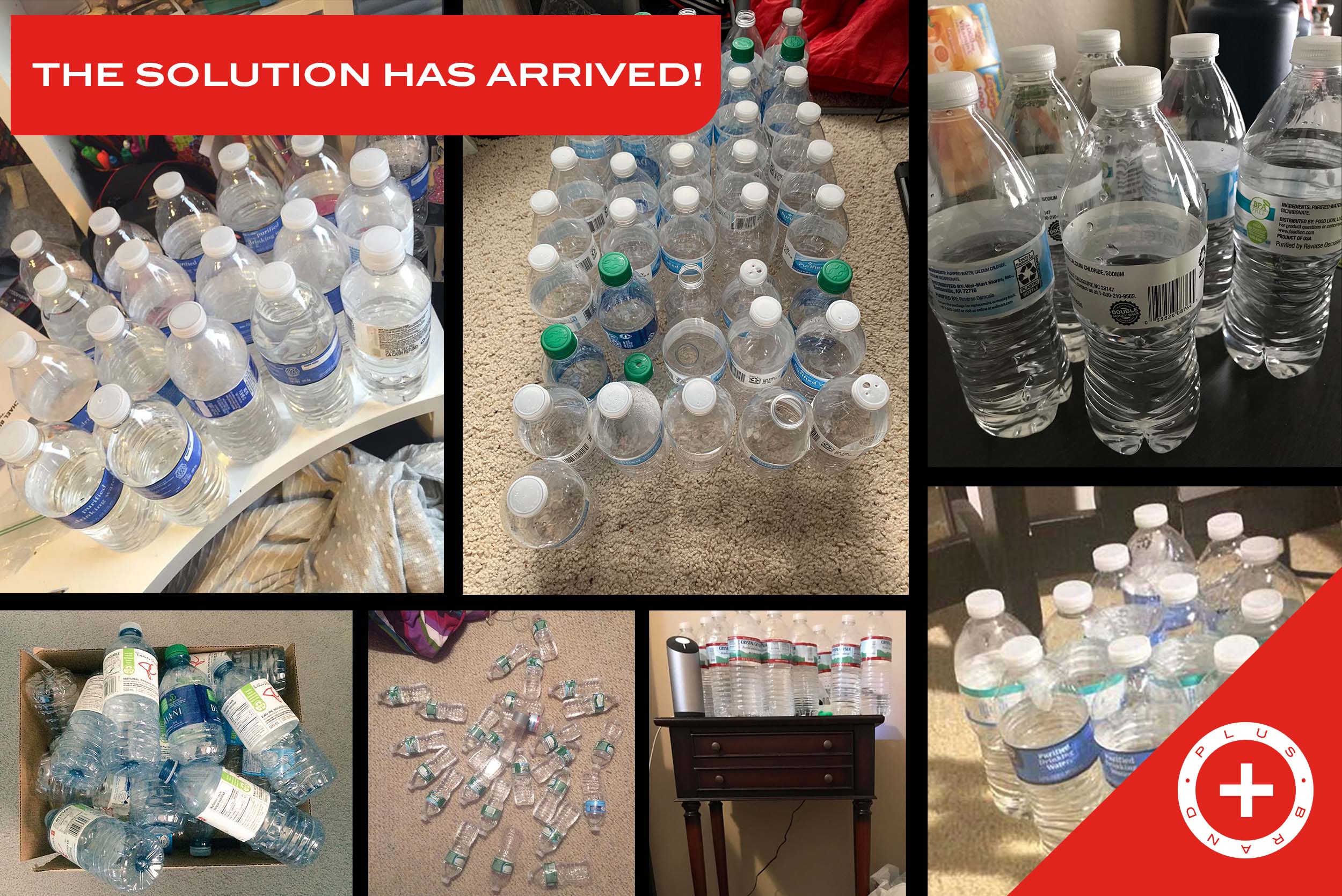
Que the morning and the remnants of the fun that took place. While they weren’t the only items left everywhere throughout the house, one was certainly the most prevalent: water bottles. And not just water bottles, but half-emptied water bottles. Everywhere. Somehow they even made their way into (but not out of) washrooms. It immediately made sense as memories of conversations taking place in every room often led to putting things down to pick someone or something up, or placing something down to share an animated story that simply HAD to involve some dramatic hand gestures. There were a million reasons why they were set down and one primary reason why they were not picked up.
CONFUSION.
They all looked the same and all of us were setting them down in different places, with different people and for different reasons. Yet when it came time to grab the water bottle again, two more were sitting right there beside and it became immediately impossible to figure out whose was whose. That’s when the light bulb went off. This happens all the time as often the beverages at a certain gathering, meeting or event are all the same. So many extra bottles are used and so much product wasted simply because no one could figure out which bottle was the one they had set down. Just like the recycling example showed us, while most are well intentioned, we typically go with the easiest solution. In this case, the easiest solution is often grabbing a new drink and leaving the old one.
While it’s easy to say “Just write your name on it!”, who has the marker or how will that even work with a cold and wet bottle covered in condensation? Like everything else, a solution was needed but it had to be simple if people were going to actually use it.
That was it. That was the moment that gave birth to a year full of formulating, testing, reformulating and retesting a solution that would allow an individual to simply scratch their name, initials or identifying image onto a product in order to identify ownership and reduce waste. It just so happens that the arrival of a global virus also gave rise to a very heightened awareness of avoiding unnecessary contact with objects that others may have touched. Water fountains were closed and businesses had to become instantly proactive when it comes to keeping customers safe. All-Scratch! Technology just happens to be the perfect solution in that instance as well as it allows the individual consuming a beverage to avoid confusion over who it belongs to and stay healthy!
Yet the simplest of solutions is not always so simple to create. Developing an innovative ink that was soft enough to scratch yet tough enough to resist rubbing, transport, heat, water, and ice at the same time is a tall technical order! Yet due to an amazing team of leading industry professionals, the idea formulated over a Christmas holiday gathering is now a reality. A reality that has created a solution for so many when it comes to eliminating one of the leading causes of waste and the transmission of germs or bacteria: Confusion.
So kiss confusion goodbye and have fun in the process as you #brandit your way!